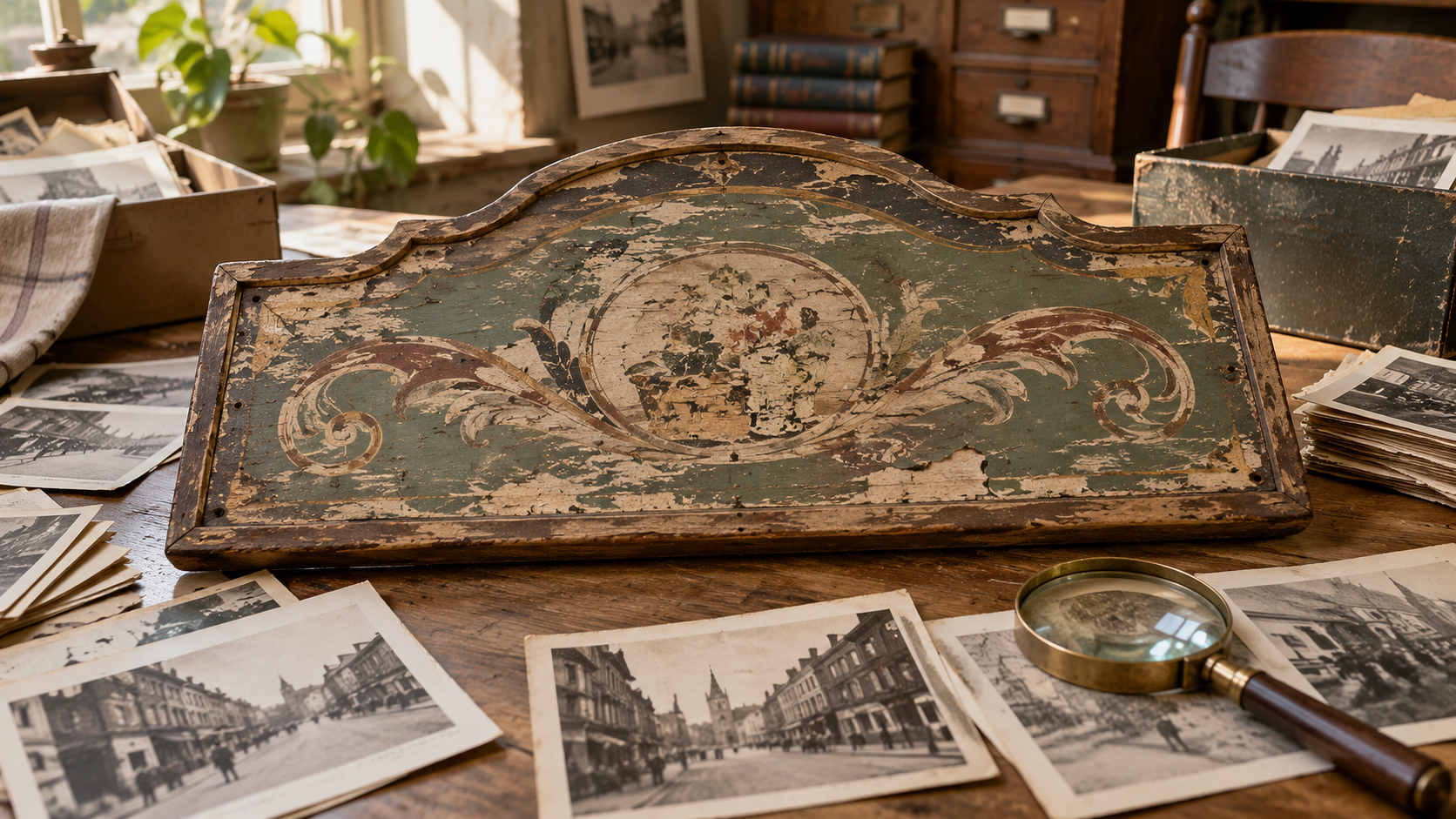
The sign was charming. Faded paint, an old lettering style and a name that sounded reassuringly established. Someone pointed at it and announced that the building must therefore be the oldest shop on the street.
The sign had supplied atmosphere. The sentence supplied several additional claims. They were being treated as one object, which is where an enjoyable local-history conversation can become a machine for manufacturing certainty.
A sign can be old without being original to a building. A business name can move. A building can change use. A style can be revived long after it was first fashionable. None of those possibilities ruins the object. They make the questions more interesting.
Separate the questions before finding the answer
I began with three lines in the notebook: when was the building made, when did this business operate here, and when was this particular sign produced or installed? The lines might eventually meet. They did not have permission to collapse together at the beginning.
My years in a print shop taught me that lettering and materials can offer clues without providing an exact date by themselves. A clue helps decide where to look next. It does not always possess the authority that a confident storyteller lends it.
I photographed the sign with permission and recorded what I could see. Not what I hoped it meant. Dimensions, material, surviving words, damage and the circumstances in which I encountered it. If part of a word was unclear, the note said unclear. A question mark is a useful piece of historical equipment.
Then I looked for records that addressed the separate questions: directories, dated photographs, maps and whatever appropriate archive material was available. I recorded the source and date of each item so that another person could follow the same trail. A remembered story received its own note, identified as a recollection rather than silently promoted into a documented fact.
Charm does not require a superlative
The oldest, the first, the only surviving example. These are attractive phrases because they give an object a simple reason to matter. They also ask for more evidence than an ordinary claim. A sign can be worth preserving and discussing without winning a competition against every sign that once existed nearby.
The stories I enjoy most often become better when the superlative falls away. A change of owner, a repair, an altered entrance or a remembered shopping routine can say more about a place than an unsupported claim that it is exceptionally ancient.
People who share memories deserve respect, including the respect of not pretending memory works like a perfectly indexed filing system. I ask what they remember, how they know it and whether something else might help fix the date. I try to preserve their words without adding the confidence they did not claim.
Sometimes the records disagree. Sometimes the useful item has not survived. The notebook should be able to end with a bounded uncertainty: this photograph shows the sign by this date; the installation date remains unresolved. That is a result another person can use.
The charming sign remains charming. Its painted surface still rewards a close look, and the name still opens a conversation with people who remember the business. The difference is that I no longer ask it to prove the entire street's history while sitting on a table.
An attractive object deserves good questions. Giving it an unsupported crown is a rather poor substitute.

A thought worth keeping?